Tag: LeadershipDevelopment

  • THE “IDENTITY GAP”

    THE “IDENTITY GAP”

    When technical authority gets lost in translation.

    “I feel like a different person when I negotiate in English.”


    I heard this from a Product Manager during a Dual-Edge Negotiation seminar I led this month. She wasn’t there for a language course; she was there to master the high-stakes strategy of sourcing laser technology for space communications.


    In her native tongue, she is:
    Exact.
    Formidable.
    Commandingly technical.


    But at the bargaining table, she felt the “Gap” open. While searching for the right phrasing to challenge a technical spec or a pricing structure, her “expert authority” would momentarily slip.

    The “Dual-Edge” Challenge

    In space-tech, you aren’t just negotiating a contract; you are negotiating a mission-critical partnership. If you lose your “voice,” you lose your leverage. The supplier starts to lead, and you find yourself sounding less sure of the technology than you actually are.

    How to bridge the Gap:

    • The Strategic Anchor: Don’t let the language dictate the terms. Center the negotiation on the data. Use technical “anchors” that force the conversation back to the physics of the deal, not the grammar.
    • The Precision Pause: In our seminar, we practiced the “strategic silence.” A pause after a technical demand signals authority and forces the supplier to provide a compliant answer.
    • Operational Simplicity: High-stakes negotiation requires clarity, not complexity. Use punchy, assertive English structures that allow your actual personality—and your expertise—to cut through the noise.


    At EBC, I provide the strategic tools for global leaders to bring their full technical authority to every deal.


    Don’t let your expertise get stuck in the atmosphere. Stop being the “translated” version of yourself. Start winning the deal.
  • Beyond the Win-Lose: Debunking the “Fixed-Pie” Myth in Negotiation

    Beyond the Win-Lose: Debunking the “Fixed-Pie” Myth in Negotiation

    In the world of high-stakes business, many professionals walk into a negotiation room with a fundamental—and often costly—misconception: the belief that every deal is a zero-sum game.

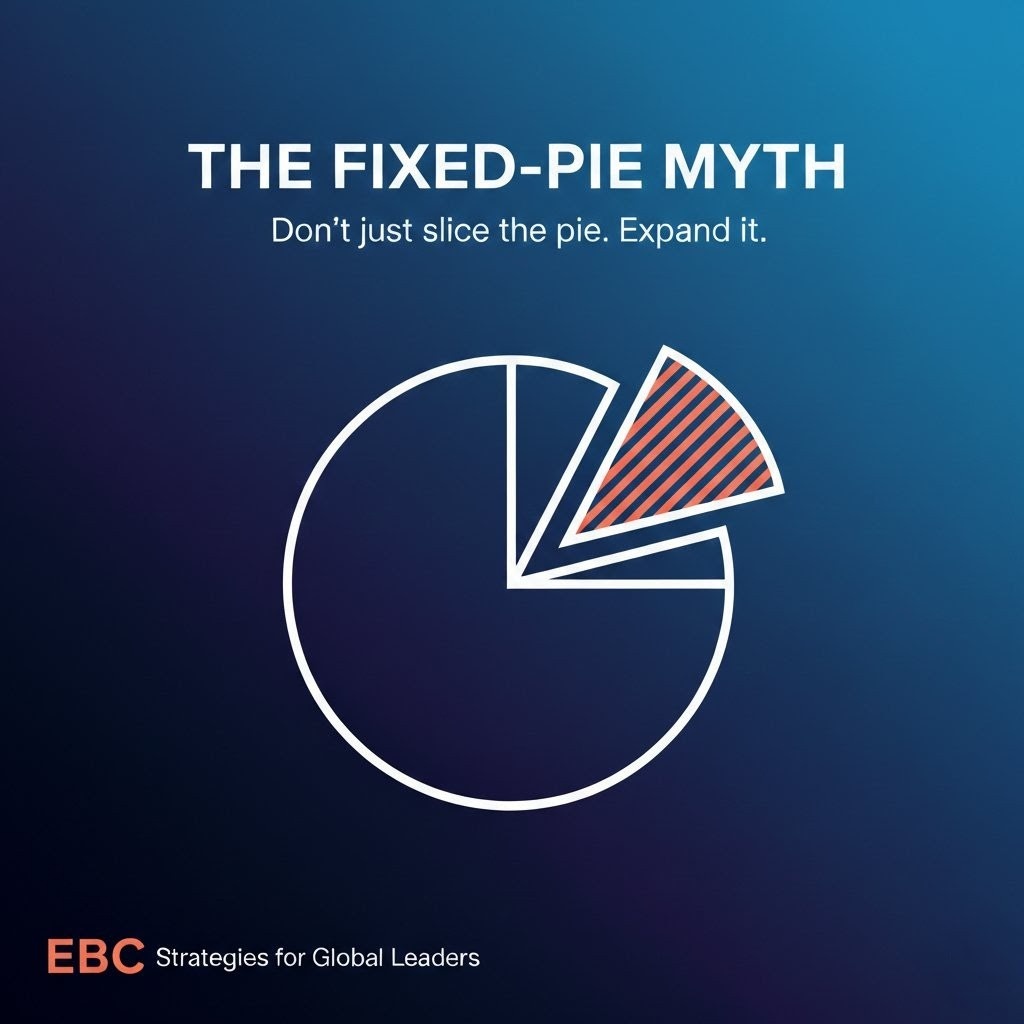
    This is known as the Fixed-Pie Myth. It is the assumption that there is only a set amount of value to be divided, and for me to get a bigger slice, you must take a smaller one. In this post, we’ll explore why this mindset stalls deals and how “integrative problem-solving” can help you bake a larger pie for everyone involved.

    The Psychology of the “Fixed Pie”

    In negotiation theory, we often distinguish between two types of bargaining:

    • Distributive Bargaining: This is the “slicing the pie” phase. It focuses on claiming value, usually on a single axis like price. It is often competitive and can lead to Lose/Lose (L/L) outcomes where both parties walk away unsatisfied.
    • Integrative Negotiation: This is the “expanding the pie” phase. It focuses on creating value. By looking at the negotiation through a different “frame,” we can identify hidden opportunities that satisfy both parties’ underlying interests.

    When you fall into the Fixed-Pie trap, you limit your creativity. You stop looking for solutions and start looking for concessions.

    4 Strategies to Expand the Value of Your Deals

    To move beyond the myth and start creating real value, try implementing these four strategies from the Global Negotiation Mastery framework:

    1. Engage in Multi-Axis Negotiation

    Stop negotiating on price alone. Price is a “fixed” variable. Instead, bring other axes to the table, such as payment terms, volume commitments, delivery timelines, or service level agreements (SLAs). By managing multiple variables simultaneously, you create “trade-off” opportunities that don’t exist in a single-issue argument.

    2. Focus on Interests, Not Positions

    A position is what someone says they want (“I need a 10% discount”). An interest is why they want it (“I need to meet my quarterly budget targets”). When you understand the “why,” you can often find a creative way to satisfy the interest without necessarily granting the position.

    3. The “Trade, Don’t Concede” Rule

    Never give something away for free. If the other party asks for a movement on price, don’t just say “yes” or “no.” Instead, use the formula: “I can move on the price if we can move the delivery date by two weeks.” This ensures that every movement is met with a reciprocal gain.

    4. Exchange Low-Cost for High-Value

    The secret to a “Win/Win” outcome is finding items that are inexpensive for you to provide but highly valuable to your counterpart. For example, offering a testimonial or a long-term contract commitment might cost you very little but provide significant value to the other side.

    Conclusion: Building Partnerships, Not Just Deals

    Debunking the Fixed-Pie Myth transforms your counterpart from an “opponent” into a “partner.” When you focus on value creation rather than just value claiming, you build trust and lay the groundwork for long-term, sustainable business relationships.


  • Why the “Directness Debt” is Killing Your Team’s Productivity

    Why the “Directness Debt” is Killing Your Team’s Productivity

    “They are just very blunt.”

    “They are being evasive.”

    “They don’t seem to have an opinion.”

    I hear these complaints every week from leaders managing international teams. They assume the problem is English fluency. They think if their team just had a better vocabulary, the friction would disappear.

    It’s a trap. You aren’t experiencing a language gap; you are experiencing a Communication Style gap.

    In my twenty years coaching international management, I’ve seen this play out in two distinct ways:

    1. 𝗟𝗼𝘄-𝗖𝗼𝗻𝘁𝗲𝘅𝘁 𝗖𝘂𝗹𝘁𝘂𝗿𝗲𝘀 (e.g., UK, USA, Germany): We say what we mean. “No” means “No.” Feedback is direct. If the language is precise, we assume the message is clear.
    2. 𝗛𝗶𝗴𝗵-𝗖𝗼𝗻𝘁𝗲𝘅𝘁 𝗖𝘂𝗹𝘁𝘂𝗿𝗲𝘀 (e.g., Spain, Japan, Brazil): The meaning is in the relationship and the environment. A “Yes” might actually mean “I heard you, but I don’t agree.”

    My job isn’t to teach more adjectives. It’s to show the whole team how to calibrate.

    Fluency without Cultural Intelligence (CQ) is dangerous. If you don’t understand the “unspoken rules” of the person across from you, your perfect English is just a loud way of being wrong.

    Stop blaming the language. Start decoding the culture.

    The most successful global leaders aren’t the ones with the biggest vocabulary; they are the ones who can translate intent, not just words.

Emotional Intelligence

Team Leadership & EQ Audit.

Professional EQ Assessment

Discover your leadership profile and unlock your impact through human-centric communication.

                        Start Now Limited Availability