Tag: Negotiation

  • Boardroom Safari: Are You the Lion, the Porcupine, or the Chameleon?

    Boardroom Safari: Are You the Lion, the Porcupine, or the Chameleon?

    Negotiation isn’t just about the numbers; it’s about the nervous systems in the room.

    When a conflict arises or a price point is challenged, your “Technical Brain” wants to talk logic. But your “Survival Brain” usually picks an animal.

    In our SSBL (Situation & Scenario Based Learning) sessions, we see leaders sabotage high-stakes deals every day because they lack awareness of their default stress response. We call this the Identity Gap—the space where your technical authority vanishes and an “animal archetype” takes over.

    Boardroom Safari: Lion, Porcupine, and Chameleon Archetypes

    Which one did you “bring to the table” this morning?

    1. The Defensive Porcupine (The “Contract Clinger”)

    The Conflict: The client asks for a 15% discount because their internal budget was slashed.

    The Reaction: You immediately point to Clause 4.2 of the signed agreement. You get defensive, your tone sharpens, and you spend 20 minutes explaining why they are “wrong” to ask.

    The EQ Fail: You’ve traded “Influence” for “Accuracy.” You might win the argument, but the relationship is poisoned.

    The Pivot: Instead of quills, use a Framing Anchor: “I understand the budget pressure. Let’s look at the project scope—which outcomes are your absolute priority to preserve?”

    2. The Invisible Chameleon (The “Peace-at-any-Price”)

    The Conflict: The other party is aggressive, pushing boundaries on the agreed-upon scope of work.

    The Reaction: You nod, take notes, and say, “We’ll see what we can do.” You blend into the background to avoid the tension, hoping the conflict will resolve itself if you stay quiet.

    The EQ Fail: You end up with a signed deal that is unprofitable and impossible to deliver. You’ve sacrificed your leverage for the price of temporary comfort.

    The Pivot: Use Strategic Silence. After they make a demand, count to five. Force them to justify the request rather than disappearing into the background.

    3. The Helpful Golden Retriever (The “Over-Explainer”)

    The Conflict: There is a misunderstanding regarding a missed technical milestone.

    The Reaction: You start apologizing. Then you explain why it happened (the server, the holiday, the flu). Then you apologize again. You offer extra free services before they even ask for compensation.

    The EQ Fail: You’ve shifted from “Strategic Partner” to “Service Provider.” By over-explaining, you’ve signaled that you lack authority, giving the other side all the power.

    The Pivot: Simplify to Amplify. State the facts once, then stop. “The milestone was missed due to a server migration. We are back on track for Tuesday. How would you like to handle the stakeholder update?”

    4. The Strategic Lion (The “Architect of Calm”)

    The Reaction: You remain calm. You don’t react; you respond. You let the tension sit in the room without rushing to fill it. You ask a high-level EQ question: “It seems like you’re concerned about the risk distribution. What would an ideal safety net look like for you?”

    The Result: You close the Identity Gap by remaining the authority figure while making the other party feel heard. This is how win-win outcomes actually happen.


    The Cost of the Safari

    In negotiation, “English” is just the vehicle. Your EQ is the driver. If you are a Porcupine in a Lion’s suit, the other side will smell it immediately. Technical expertise gets you the meeting, but your ability to manage your “animal response” determines if you lead the partnership.

    How do you react under fire?

    Do you stay the Lion, or do you start growing quills?

    Our 50-point Leadership EQ Audit is designed to stress-test your negotiation persona. It identifies your default animal archetype and gives you the specific “Pivots” needed to maintain your Strategic Edge when the conflict gets loud.

    Stop guessing your impact. Get the data.

    Take the EQ Audit & Find Your Archetype


    EBC | Strategies for Global Leaders

  • The Analytics “Priority Paradox”: Why RICE is Your Best Negotiation Asset

    The Analytics “Priority Paradox”: Why RICE is Your Best Negotiation Asset

    In Digital Analytics, everyone wants their dashboard “yesterday.”

    I’ve been discussing with a Digital Analytics Manager at BBVA recently how to navigate the relentless “firehose” of data requests.

    Whether it’s Marketing wanting campaign tracking, Risk needing a compliance audit, or Product requesting a behavioral deep-dive, the pressure is constant.

    As we discussed, if you don’t have a framework to manage these trade-offs, you aren’t a Manager—you’re a “Ticket Taker.”

    That’s why I advocate for the RICE Framework not just as a formula, but as a strategic negotiation tool.

    The Analytics Edge of RICE

    • Reach: How many customers in the digital funnel does this tracking affect?
    • Impact: Will this data actually drive a conversion lift, or is it just “vanity reporting”?
    • Confidence: Do we have the data integrity to support this insight? (Crucial for banking).
    • Effort: How many “Sprints” will the implementation team need to ship this?

    How to Use RICE to Negotiate

    When you lead these discussions in a global, English-speaking environment, RICE helps close the Identity Gap:

    1. Objectifying the “No”: Instead of saying “We don’t have time,” you can say: “Based on the RICE score, the Impact-to-Effort ratio for the tracking update is lower than the Risk-Compliance audit.”
    2. Defending Data Integrity: Use the Confidence score to push back on shaky data requests. It signals your technical authority.
    3. Strategic Alignment: It moves you from “The Data Person” to “The Strategic Partner” who understands the bank’s bottom line.

    At EBC, I help Analytics Leaders master the “Dual-Edge” of data and negotiation. Being right about the data is only half the battle—you have to be able to sell the priority.

    Stop being a ticket taker. Start being a strategist.

  • Beyond the Win-Lose: Debunking the “Fixed-Pie” Myth in Negotiation

    Beyond the Win-Lose: Debunking the “Fixed-Pie” Myth in Negotiation

    In the world of high-stakes business, many professionals walk into a negotiation room with a fundamental—and often costly—misconception: the belief that every deal is a zero-sum game.

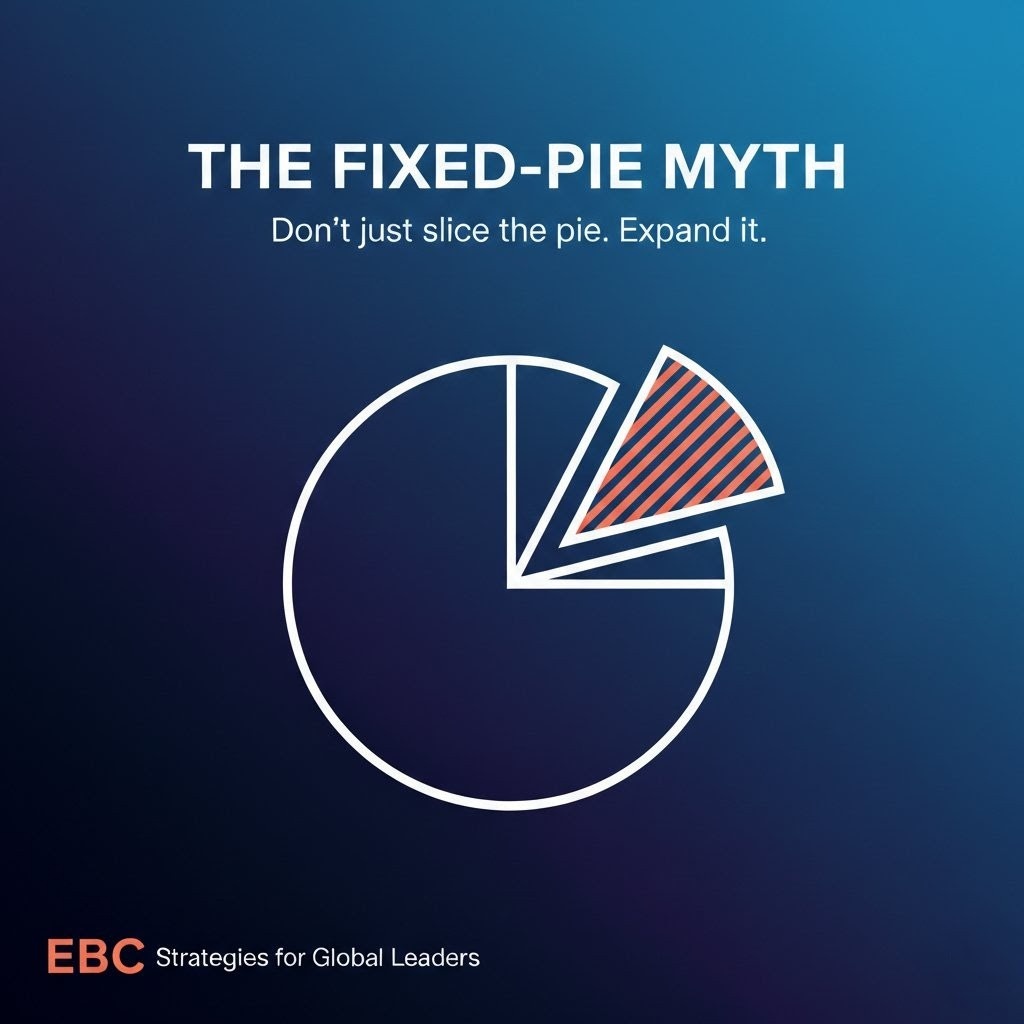
    This is known as the Fixed-Pie Myth. It is the assumption that there is only a set amount of value to be divided, and for me to get a bigger slice, you must take a smaller one. In this post, we’ll explore why this mindset stalls deals and how “integrative problem-solving” can help you bake a larger pie for everyone involved.

    The Psychology of the “Fixed Pie”

    In negotiation theory, we often distinguish between two types of bargaining:

    • Distributive Bargaining: This is the “slicing the pie” phase. It focuses on claiming value, usually on a single axis like price. It is often competitive and can lead to Lose/Lose (L/L) outcomes where both parties walk away unsatisfied.
    • Integrative Negotiation: This is the “expanding the pie” phase. It focuses on creating value. By looking at the negotiation through a different “frame,” we can identify hidden opportunities that satisfy both parties’ underlying interests.

    When you fall into the Fixed-Pie trap, you limit your creativity. You stop looking for solutions and start looking for concessions.

    4 Strategies to Expand the Value of Your Deals

    To move beyond the myth and start creating real value, try implementing these four strategies from the Global Negotiation Mastery framework:

    1. Engage in Multi-Axis Negotiation

    Stop negotiating on price alone. Price is a “fixed” variable. Instead, bring other axes to the table, such as payment terms, volume commitments, delivery timelines, or service level agreements (SLAs). By managing multiple variables simultaneously, you create “trade-off” opportunities that don’t exist in a single-issue argument.

    2. Focus on Interests, Not Positions

    A position is what someone says they want (“I need a 10% discount”). An interest is why they want it (“I need to meet my quarterly budget targets”). When you understand the “why,” you can often find a creative way to satisfy the interest without necessarily granting the position.

    3. The “Trade, Don’t Concede” Rule

    Never give something away for free. If the other party asks for a movement on price, don’t just say “yes” or “no.” Instead, use the formula: “I can move on the price if we can move the delivery date by two weeks.” This ensures that every movement is met with a reciprocal gain.

    4. Exchange Low-Cost for High-Value

    The secret to a “Win/Win” outcome is finding items that are inexpensive for you to provide but highly valuable to your counterpart. For example, offering a testimonial or a long-term contract commitment might cost you very little but provide significant value to the other side.

    Conclusion: Building Partnerships, Not Just Deals

    Debunking the Fixed-Pie Myth transforms your counterpart from an “opponent” into a “partner.” When you focus on value creation rather than just value claiming, you build trust and lay the groundwork for long-term, sustainable business relationships.


Emotional Intelligence

Team Leadership & EQ Audit.

Professional EQ Assessment

Discover your leadership profile and unlock your impact through human-centric communication.

                        Start Now Limited Availability