“Tell me and I forget, teach me and I may remember, involve me and I learn.”
— Benjamin Franklin
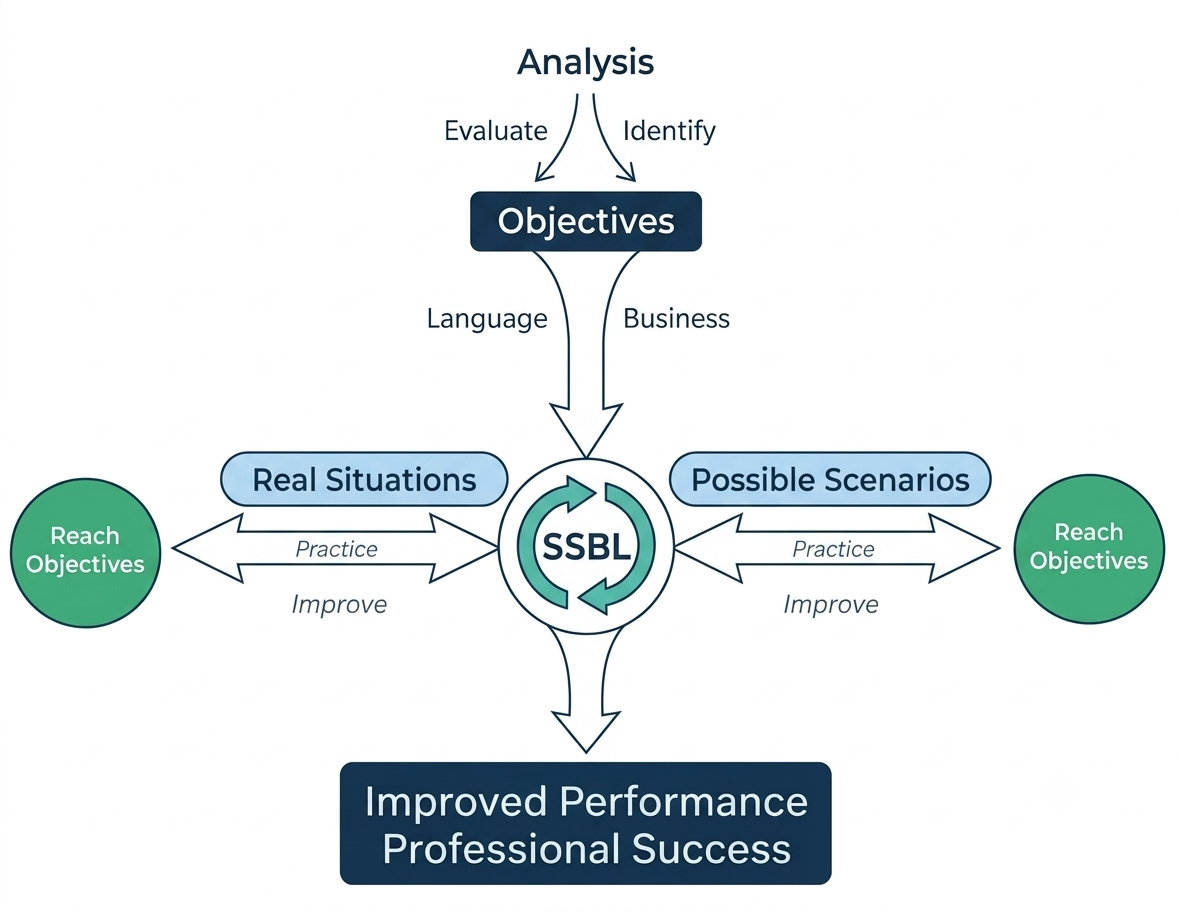
First introduced in the early 1990s, Situation & Scenario-Based Learning (SSBL) has evolved into one of the core pedagogical principles powering effective professional learning environments. Rather than focusing on abstract theory, SSBL drives motivation and participant engagement by anchoring training in situations and scenarios directly relevant to their day-to-day work.
1. Situation-Based Learning (SBL)
Situation-Based Learning operates on the principle that people retain knowledge more effectively through active participation than passive consumption. When applied to fields like professional communication or language acquisition, participants learn far faster when immersed in specific, realistic situations.
Instead of working through generic study materials, the participant’s own professional context becomes the curriculum. This tailored approach builds immediate confidence and equips learners to perform key tasks more successfully.
Practical Application: Role-Playing Real-World Tasks
Consider a professional preparing for a high-stakes meeting. Rather than studying generic presentation skills, coaching sessions revolve around simulating the actual meeting.
Through role-play in a controlled setting, the participant refines critical execution factors, including:
- Projecting confidence and persuasive delivery
- Managing body language and non-verbal cues
- Refining targeted language and tone
- Developing cultural awareness and flexible negotiation strategies
2. Scenario-Based Learning (SBL)
Scenario-Based Learning integrates Problem-Based Learning (PBL) and critical-thinking exercises. Participants evaluate, discuss, and navigate multiple potential outcomes stemming from a given situation.
By practicing complex decision-making within a safe learning environment, individuals significantly improve their decision quality when facing similar challenges in real life. This approach is especially powerful for organizations, as collaborative problem-solving strengthens team cohesion and morale.
Practical Application: Crisis Management & Strategy
Imagine a team guiding a business through financial uncertainty. Coaching sessions use PBL to explore potential scenarios and test solutions risk-free.
Activities might include:
- Conducting a targeted SWOT analysis to evaluate internal and external factors
- Brainstorming and testing key strategies, such as restructuring operations, streamlining processes, or pivoting business models
- Evaluating the risk profile and expected outcomes of each alternative scenario
Maximizing Impact: Practice & Cultural Intelligence
To ensure long-term knowledge retention, SSBL requires deliberate repetition and meaningful practice. Without consistent application, even highly relevant insights fade over time.
When structured correctly, SSBL delivers a rich, adaptable environment where learners quickly master real-world challenges. It is particularly valuable in today’s globalized workplace: while cross-cultural interactions are common, navigating them effectively requires nuanced skills. SSBL provides the exact situational framework needed to build intercultural competence.
About the Author
Todd Bagnall empowers professionals to unlock their full potential through targeted communication strategies and leadership coaching.
Connect or get in touch: info@englishbusinesscoach.com