
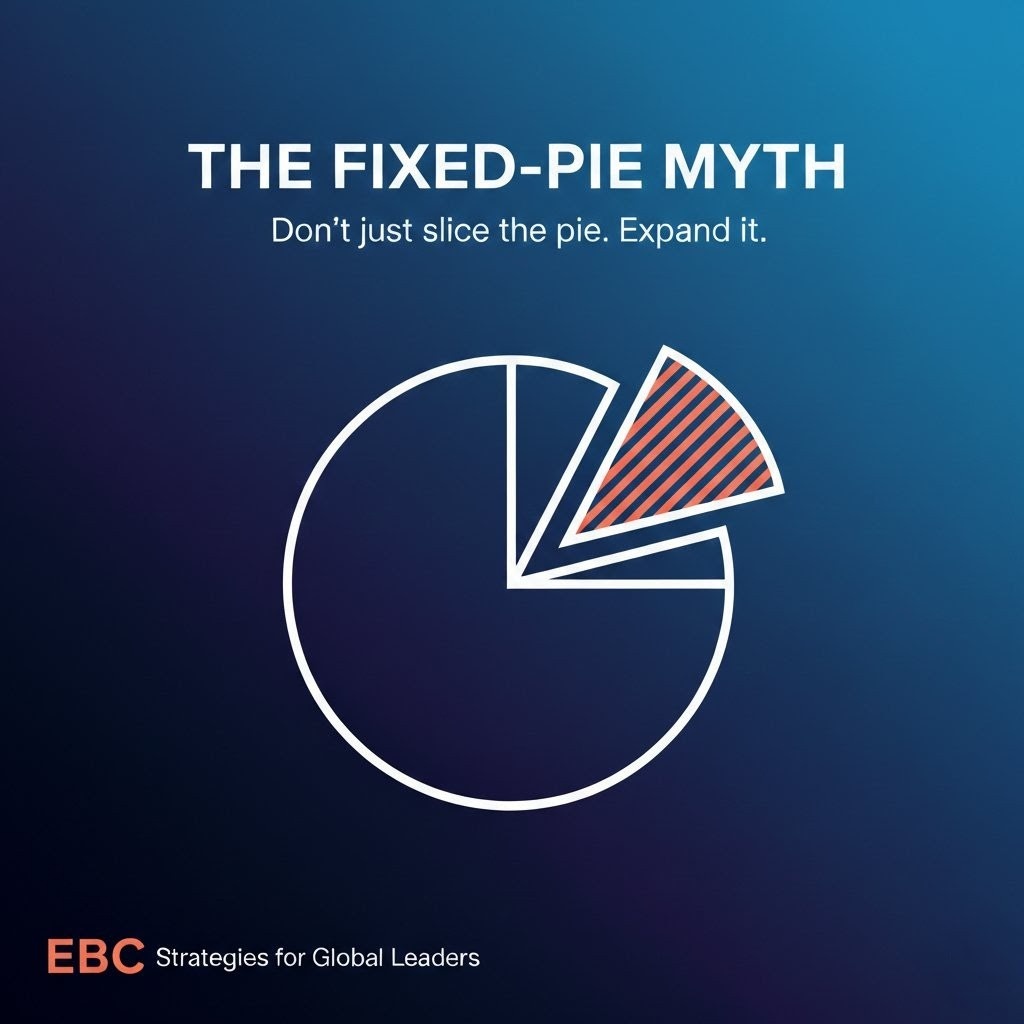
In the world of high-stakes business, many professionals walk into a negotiation room with a fundamental—and often costly—misconception: the belief that every deal is a zero-sum game.
This is known as the Fixed-Pie Myth. It is the assumption that there is only a set amount of value to be divided, and for me to get a bigger slice, you must take a smaller one. In this post, we’ll explore why this mindset stalls deals and how “integrative problem-solving” can help you bake a larger pie for everyone involved.
The Psychology of the “Fixed Pie”
In negotiation theory, we often distinguish between two types of bargaining:
- Distributive Bargaining: This is the “slicing the pie” phase. It focuses on claiming value, usually on a single axis like price. It is often competitive and can lead to Lose/Lose (L/L) outcomes where both parties walk away unsatisfied.
- Integrative Negotiation: This is the “expanding the pie” phase. It focuses on creating value. By looking at the negotiation through a different “frame,” we can identify hidden opportunities that satisfy both parties’ underlying interests.
When you fall into the Fixed-Pie trap, you limit your creativity. You stop looking for solutions and start looking for concessions.
4 Strategies to Expand the Value of Your Deals
To move beyond the myth and start creating real value, try implementing these four strategies from the Global Negotiation Mastery framework:
1. Engage in Multi-Axis Negotiation
Stop negotiating on price alone. Price is a “fixed” variable. Instead, bring other axes to the table, such as payment terms, volume commitments, delivery timelines, or service level agreements (SLAs). By managing multiple variables simultaneously, you create “trade-off” opportunities that don’t exist in a single-issue argument.

2. Focus on Interests, Not Positions
A position is what someone says they want (“I need a 10% discount”). An interest is why they want it (“I need to meet my quarterly budget targets”). When you understand the “why,” you can often find a creative way to satisfy the interest without necessarily granting the position.
3. The “Trade, Don’t Concede” Rule
Never give something away for free. If the other party asks for a movement on price, don’t just say “yes” or “no.” Instead, use the formula: “I can move on the price if we can move the delivery date by two weeks.” This ensures that every movement is met with a reciprocal gain.
4. Exchange Low-Cost for High-Value
The secret to a “Win/Win” outcome is finding items that are inexpensive for you to provide but highly valuable to your counterpart. For example, offering a testimonial or a long-term contract commitment might cost you very little but provide significant value to the other side.
Conclusion: Building Partnerships, Not Just Deals
Debunking the Fixed-Pie Myth transforms your counterpart from an “opponent” into a “partner.” When you focus on value creation rather than just value claiming, you build trust and lay the groundwork for long-term, sustainable business relationships.